



What is an Interface Brush? How to Choose and Use One?
Don't put off your smile. Message us now to discuss your treatment options with our expert dentists.
WhatsAppWhen it comes to oral and dental health, most people think of brushing their teeth twice a day. However, modern dentistry data proves that brushing alone is not enough to ensure complete hygiene. Teeth are like cubic structures with five different surfaces. While a standard brush can clean the front, back, and chewing surfaces, the side walls where teeth lean against each other remain too narrow and closed for bristles to reach. This is exactly where using an interface brush comes in as a vital complement to your oral care routine.
The simplest answer to the question "What is an interface brush?" is that it is the guardian of unreachable areas between the teeth. These brushes can prevent a wide range of problems, from gum recession and chronic bad breath to hidden interproximal cavities and implant failure. In this guide, we will take a deep dive into the world of this small but revolutionary tool.
Table of Content
- What is an Interface Brush? Why Brushing Alone Isn’t Enough
- Interface Brush Sizes and Colors: Which Size is Right for You?
- How to Use an Interface Brush?
- Interface Brush vs. Dental Floss: Which Should You Choose?
- My Gums Bleed When Using an Interface Brush, What Should I Do?
- How Long Can an Interface Brush Be Used?
- Use in Special Cases: Implants, Bridges, and Orthodontics
- FAQ
What is an Interface Brush? Why Brushing Alone Isn’t Enough
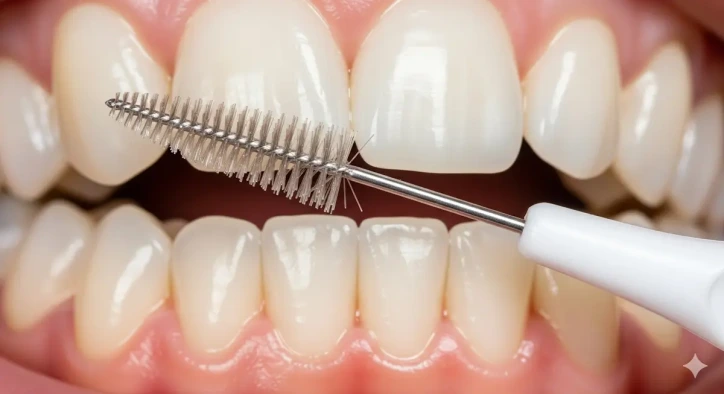
An interface brush is a structure resembling a miniature bottle brush, with a thin wire at its center surrounded by soft polymer bristles. It is specifically designed to enter the triangular gaps at the junction points of the teeth.
So, why isn't brushing alone enough? Due to the nature of their bristles, standard toothbrushes cannot penetrate between the teeth. The bacterial plaque, known as "biofilm," that accumulates in these areas will harden over time into tartar (calculus) if not removed. The answer to what an interface brush does is quite clear: it helps clean the food debris and bacterial plaque that accumulates on the side surfaces of the teeth which a standard toothbrush cannot reach.
Plaque accumulating in these interface areas can irritate the gums and lead to inflammation. Even if your gums look healthy while brushing, hidden inflammation between the teeth can threaten your entire oral health over time.
Interface Brush Sizes and Colors: Which Size is Right for You?
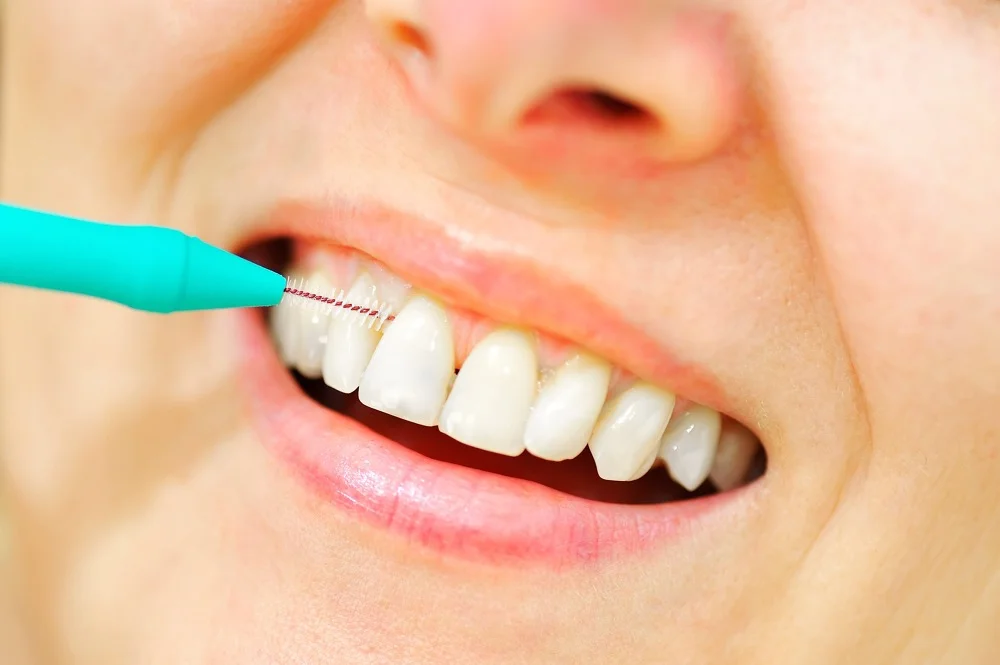
The most common mistake in interdental cleaning is choosing the wrong brush size. There are many different colors and millimetric measurements available on the market. Interface brush sizes represent the thickness of the bristles and the diameter of the central wire. Choosing the right size is critical to avoid damaging the gums while ensuring thorough cleaning.
So, how many mm should an interdental brush be? The answer depends entirely on the gaps between your teeth:
- For Very Narrow Gaps: Generally, the thinnest models, such as 0.4 mm or 0.45 mm (often pink or orange), are preferred.
- For Medium-Sized Gaps: Brushes between 0.5 mm and 0.7 mm (yellow, red, blue) are suitable.
- For Wide Gaps or Around Implants: Thicker brushes of 0.8 mm and above (green, purple, grey) are used.
The golden rule when choosing an interface brush is this: you should feel a slight resistance as the brush enters between the teeth, but you should never force it. If you have to use excessive force to push the brush in, that size is too thick for you. If it wobbles in the gap without touching anything, it is too thin. Most people may need to use two different sizes for different areas of the mouth; the gaps between front teeth are usually narrower, while the back areas may be wider.
How to Use an Interface Brush?
Just as important as buying the right product is understanding the correct technique for using an interface brush. Forcing it at the wrong angle can damage the gums. Here is the step-by-step application method:
- Identify the Correct Angle: When placing the brush between your teeth, find the appropriate gap by tilting it slightly up or down without putting pressure on the gums.
- Push Gently: Insert the brush between the teeth. Stop when you feel slight resistance and ensure the tip of the brush emerges from the other side.
- Back-and-Forth Motion: It is sufficient to push the brush in once and pull it out once. There is no need for hard, fast movements like brushing your teeth.
- Use a Mirror: Especially when working on the back teeth, using a mirror helps you adjust the direction of the brush correctly.
- Rinse: After cleaning each interdental space, rinse the plaque off the tip of the brush with water and move to the next gap.
You do not need to use toothpaste during this process. Mechanical cleaning with water alone is sufficient to remove plaque. However, if your dentist has recommended a special gel for gum recession or sensitivity, you can apply it to the tip of the brush.
Interface Brush vs. Dental Floss: Which Should You Choose?
One of the most common questions in dentistry is: dental floss or interface brush? While both have their advantages, modern studies show that interdental brushes are more effective than floss at removing plaque.
Dental floss is irreplaceable in areas where teeth are in very tight contact and even the thinnest interdental brush cannot enter. However, if there is even a small gap between the teeth, the bristles of the interface brush can sweep the concave surfaces in that area much better. While floss moves in a straight line, the brush fills the entire space to clean. As a general rule: if your teeth are very tightly aligned, choose floss; if you use implants or prosthetics, or if gaps have formed due to gum recession, you should prefer an interface brush. In many cases, a combination of both yields the best results.
My Gums Bleed When Using an Interface Brush, What Should I Do?
The biggest concern for patients starting to use an interface brush for the first time is slight bleeding during the process. Many people stop using it out of fear that the brush is cutting their gums. However, the truth is quite the opposite.
Gum bleeding is a sign of inflammation (gingivitis) caused by bacteria accumulated in that area. Your gums are not reacting to the brush, but to the bacteria living there. If you continue to clean the interdental spaces regularly, the inflammation will usually dissipate within 7–10 days, and the bleeding will stop completely. If you still experience severe bleeding, pain, or swelling after this period, it may be a sign of a deeper infection under your gums. At this point, you should consult a dentist for professional tartar cleaning.
How Long Can an Interface Brush Be Used?
Standard toothbrushes are changed every 3 months, but the lifespan of an interface brush is much shorter. Because these brushes have a delicate structure, their wires can bend and their bristles can wear out. Generally, a high-quality interface brush can lose its function within 1 to 2 weeks, depending on your frequency of use and technique. You should definitely replace the brush if:
- The wires of the brush are bent or have lost their flexibility.
- The bristles start to shed or thin out.
- The tip of the brush is deformed and has difficulty entering between the teeth.
- You have had an infectious disease (flu, cold, etc.).
Using a dirty or deformed brush can damage your gums and cause bacteria to spread rather than cleaning.
Use in Special Cases: Implants, Bridges, and Orthodontics
In some cases, the interface brush is not a choice but a vital necessity. If you have structures in your mouth other than natural teeth, you need to double your cleaning routine.
Braces (Orthodontics)
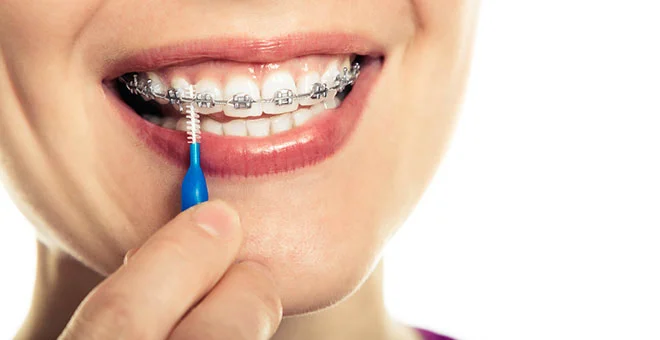
The orthodontic interface brush is the only way to reach the areas behind and between the wires (brackets). Classic brushes get caught on the wires and cannot enter the interdental areas. Food debris accumulating around the brackets can quickly cause cavities.
Implants
Even though implants do not decay, the gums and bone tissue around them are very sensitive to infection. To extend the life of the implant, metal parts should not be exposed to plaque. Therefore, they should be cleaned gently with interdental brushes that have plastic-coated wires.
Bridge Prosthetics
The areas under the "pontic" (the part of the bridge that replaces the missing tooth) are the most prone to bacterial accumulation. Specialized interface brushes can ensure the maintenance of tissue health in under-bridge cleaning.
|
Dental Structure / Condition |
Recommended Brush Type |
Frequency of Use |
|
Very Tight Teeth |
0.4 mm - 0.45 mm (Thin) |
Once a day (Evening) |
|
Standard Gaps |
0.5 mm - 0.7 mm (Medium) |
1-2 times a day |
|
Braces (Orthodontics) |
Tapered or Pine-tree models |
After every meal |
|
Implants & Under Bridges |
Plastic-Coated / Thick models |
Twice a day |
FAQ
How many times a day should an interface brush be used?
Generally, using it once a day is sufficient. However, if you are using braces or dental bridges, your dentist may ask you to increase this frequency.
How many uses before an interface brush should be discarded?
The brush should be discarded when the bristles become deformed or the wire bends (usually within 1-2 weeks). For hygiene purposes, single-use models are also available.
Does an interface brush create gaps between teeth?
This is one of the biggest urban myths. A brush of the correct size does not open gaps between teeth. The feeling of space created is actually due to the gums returning to their healthy, original form after the removal of tartar and plaque that had caused them to swell.
Is using an interface brush healthy?
Absolutely yes. It is considered by dentists to be the most effective tool for interdental cleaning. It is clinically proven to prevent gum disease and interproximal cavities.
About the Author