


Dental Bridge or Implant? Which is Better & Long-Lasting?
Don't put off your smile. Message us now to discuss your treatment options with our expert dentists.
WhatsAppThroughout life, poor oral hygiene, advanced periodontal disease, deep decay, or sudden traumatic impacts can cause the loss of one or more teeth. Every single missing tooth does not simply disrupt the aesthetic symmetry of a smile; it systematically weakens chewing efficiency, compromises natural speech articulation, and triggers rapid bone resorption within the jaw over time. Furthermore, leaving even a single structural gap causes adjacent teeth to slowly tip into the empty space and teeth in the opposite arch to over-erupt, throwing off the entire biomechanical balance of your occlusion.
Modern restorative dentistry offers two highly developed treatment options to close these gaps and return the oral architecture to full function. However, the most frequent dilemma facing patients during the planning stages is this: Dental bridge or implant?
While both methodologies successfully restore missing spaces, their mechanical engineering, relationship with the jawbone, and treatment of adjacent teeth are completely distinct. This detailed guide covers all clinical variables to help you determine the optimal choice for your oral health.
Table of Content
- Is a Dental Bridge or Implant Better for Missing Teeth?
- Comparing the Clinical Performance of Bridges and Implants
- Zirconium Bridge vs. Implant: Aesthetic Zone Management
- How Many Years Does a Dental Bridge Last?
- What is the Expected Lifespan of a Dental Implant?
- Comprehensive Clinical Decision Framework
- Frequently Asked Questions
Is a Dental Bridge or Implant Better for Missing Teeth?
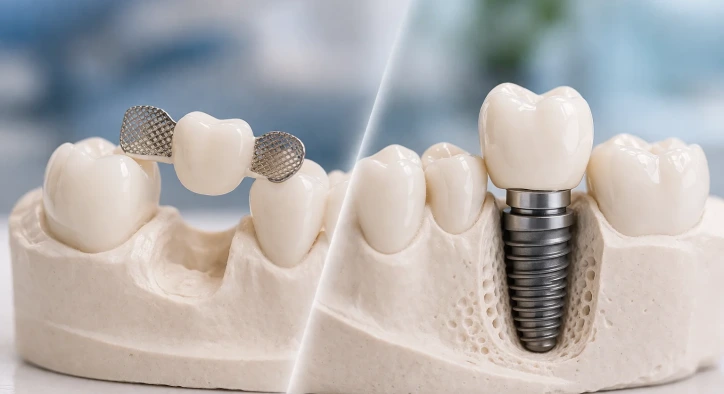
To fully evaluate the choice of dental bridge or implant for tooth replacement, you must analyze the structural mechanics of how each system operates inside the mouth:
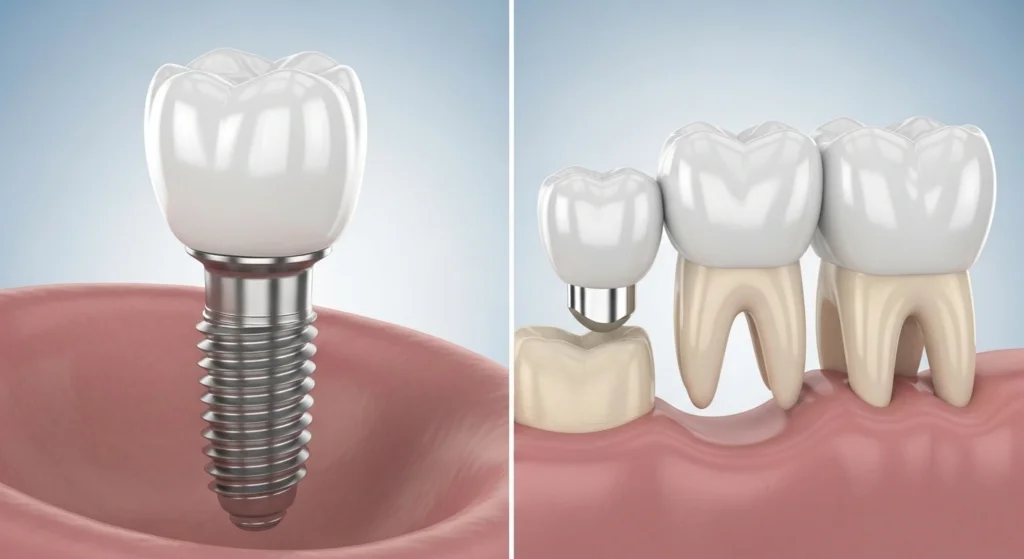
- Dental Implant (Artificial Tooth Root): Consists of a medical-grade titanium screw surgically positioned directly into the jawbone matrix. This screw replicates the natural root structure. Once completely fused with the surrounding living bone cells (a biological process called osseointegration), a premium porcelain or zirconium crown is permanently screwed or cemented on top. The implant stands as a standalone structure, completely independent of adjacent teeth.
- Traditional Dental Bridge: Relies entirely on using the healthy teeth adjacent to the gap as primary structural anchors (abutments). To receive the bridge framework, these neighboring anchor teeth must be significantly shaved down and reduced in size. A multi-unit prosthetic block containing the artificial suspension tooth (pontic) connected to the hollow anchor crowns is then permanently cemented over the prepped structures.
Comparing the Clinical Performance of Bridges and Implants
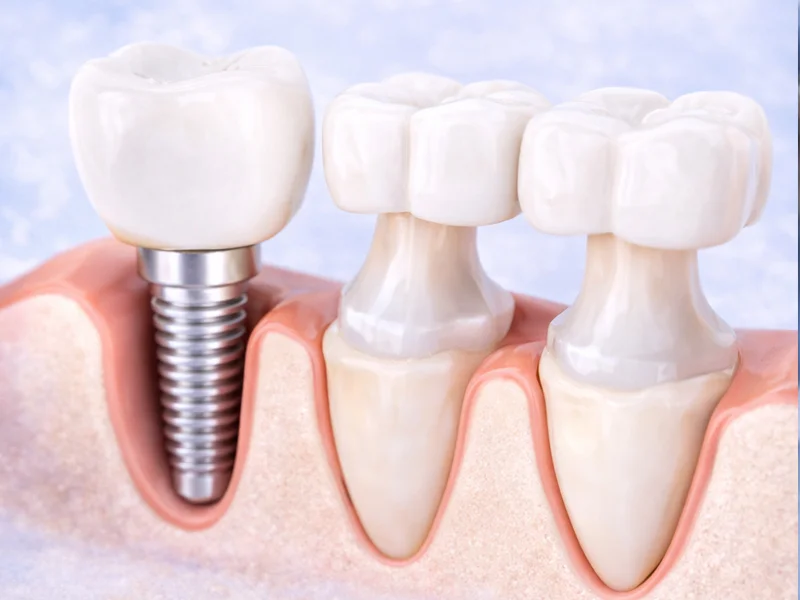
When solving the puzzle of which is better bridge or implant, the decision relies on tissue conservation and long-term biological success. From a contemporary clinical standpoint, dental implants are considered the absolute gold standard for teeth replacement.
Enamel and Tooth Structure Conservation
- Implant: The teeth adjacent to the missing gap are kept fully intact. Their healthy natural enamel layer is never touched, preserved completely in its original form.
- Bridge: Even if the neighboring anchor teeth are entirely healthy, pristine, and free of decay, they must undergo irreversible circumferential reduction (shaving) to hold the bridge. This results in the loss of healthy tooth structure solely for mechanical retention.
Bone Matrix Preservation and Long-Term Resorption
- Implant: Directly transfers physical biting forces through the titanium post down into the alveolar bone, exactly like a natural tooth root. This functional mechanical loading stimulates the bone tissue, keeping it dense and healthy. Consequently, implants stop the jawbone melting (atrophy) that naturally follows tooth extraction.
- Bridge: Because the suspension tooth hangs suspended above the tissue, no mechanical stimulation is delivered to the underlying bone matrix. Lacking functional stimulation, the jawbone beneath the bridge continues to resorb over time, creating a structural collapse of the gumline.
Zirconium Bridge vs. Implant: Aesthetic Zone Management
For tooth replacement within the visible smile line, aesthetic requirements often lead patients to query the difference between a zirconium bridge vs implant:
- If the neighboring teeth flanking the gap already present massive old silver fillings, deep decay, or severe aesthetic staining, grinding them down is beneficial. In this scenario, a zirconium bridge can simultaneously close the gap and restore the neighboring teeth into a beautifully uniform, high-translucency smile layout within a short timeframe.
- However, if the adjacent teeth are entirely pristine, un-restored, and healthy, choosing a dental implant is highly recommended to protect the healthy tooth structures from unnecessary modification, even in the aesthetic zone.
How Many Years Does a Dental Bridge Last?
When fabricated using precise laboratory techniques and supported by diligent oral home care, a high-grade traditional dental bridge lasts an average of 7 to 10 years. Over this timeframe, the underlying luting cements can gradually undergo micro-leakage. Food debris can collect beneath the pontic, causing secondary decay along the anchor roots or leading to localized periodontal bone loss. Consequently, bridges must eventually be removed and refabricated.
What is the Expected Lifespan of a Dental Implant?
In contrast, once a premium titanium implant achieves successful molecular integration with the jawbone matrix, its structural lifespan is permanent and can last a lifetime, provided the patient maintains regular professional check-ups. While the outer porcelain or zirconium crown may experience standard material wear and require replacement after many years, the underlying artificial titanium root remains securely integrated forever.
Comprehensive Clinical Decision Framework
When choosing the right material and method for treating missing teeth, dentists consider the following clinical criteria:
|
Clinical Scenario & Patient Preference |
Dental Implant Therapy |
Traditional Dental Bridge Restoration |
|
Adjacent Anchor Teeth Integrity |
The Ideal Selection: Keeps neighboring teeth fully intact; their healthy natural enamel matrices are never touched. |
Recommended if adjacent structures are already heavily compromised, containing massive silver fillings, root canals, or requiring full crowns. |
|
Alveolar Bone Volume Status |
Requires sufficient bone height and structural density for stable integration (otherwise, bone grafting is mandatory). |
Can be successfully anchored regardless of localized bone atrophy or soft tissue collapse beneath the missing area. |
|
Treatment Timeline & Scope |
Requires structural patience, involving a multi-month osseointegration window (typically 2 to 3 months) before the final crown. |
The Accelerated Route: The entire structural configuration is completely finished and cemented within 1 to 2 weeks. |
|
Systemic Medical Markers |
Minor oral surgery is required; unmanaged systemic disorders or compromised healing patterns pose clinical risks. |
Bypasses surgical environments entirely, making it safe for individuals with systemic restrictions against minor surgical treatments. |
Frequently Asked Questions
Is a traditional dental bridge or a dental implant more expensive?
In terms of initial up-front cost, a dental implant requires a larger financial investment due to the advanced surgical components, bio-compatible titanium manufacturing, and specialized surgical expertise involved. However, when evaluated over a long-term 10-to-20-year window, the recurring cost of removing, resizing, and refabricating traditional bridges makes permanent implant therapy the more cost-effective and conservative investment over time.
How do you clean underneath a dental bridge? How can I eliminate bad odors?
Because dental bridges are cemented as a solid multi-unit block, a microscopic space remains between the suspended artificial tooth (pontic) and the underlying gum tissue. Standard toothbrushes cannot reach this space. Left uncleaned, food particles and oral biofilms accumulate underneath, leading to chronic bad breath (halitosis) and localized gum inflammation. To clean a bridge properly, you must implement specialized bridge floss daily to slide beneath the framework, alongside an intraoral water flosser to flush out hidden debris.
Is the surgical placement of a dental implant painful?
Absolutely not. The entire surgical phase is managed under advanced localized anesthetic blocks that completely numb the area, and jawbone tissue lacks direct pain-sensing nerve endings. Patients typically experience only a mild physical vibration and light pressure during the procedure. Any minor post-operative soreness or tenderness felt during the initial 48 hours is easily managed using standard anti-inflammatory painkillers prescribed by your surgeon.
About the Author