


What Are Inlay and Onlay Fillings? Porcelain Filling Prices 2026
Don't put off your smile. Message us now to discuss your treatment options with our expert dentists.
WhatsAppThe fundamental philosophy of modern dentistry is to minimize intervention on the healthy, original tissue of a tooth while restoring structures that have suffered tissue loss due to decay or trauma. In traditional methods, when a large molar experienced extensive decay, clinicians would either perform a standard direct composite restoration or shaved the tooth circumferentially for a full dental crown. However, direct composite fillings carry risks of micro-fracturing or marginal leakage over time when subjected to massive chewing forces; full crowns, on the other hand, result in unnecessary reduction of healthy dental enamel.
Situated precisely between these two traditional methods, inlay onlay filling applications represent the most advanced conservative technology, providing protection as strong and aesthetic as a full crown while preserving natural tooth structure to the maximum extent. Manufactured with micron-level precision in a laboratory setting using computer-aided design and manufacturing (CAD/CAM) systems, these restorations are considered the absolute gold standard for saving heavily broken posterior chewing teeth.
Table of Content
What is an Inlay Onlay Filling?
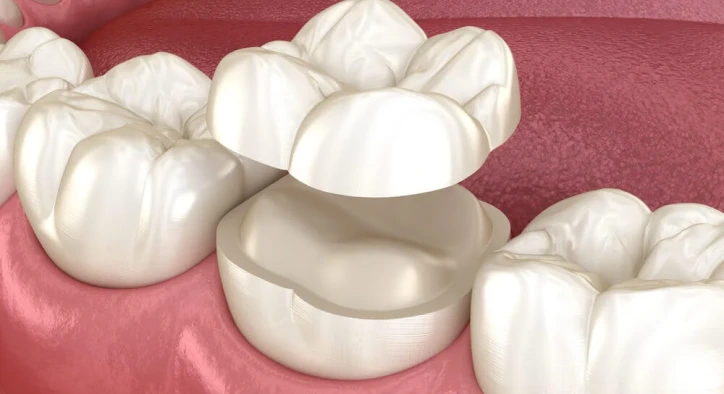
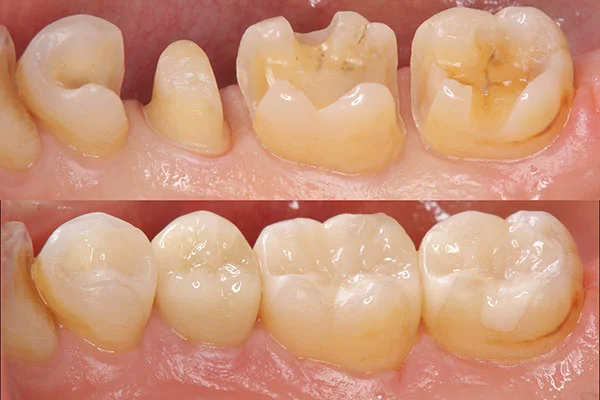
Belonging to the class of "indirect restorations" in dental literature, the most direct scientific answer to what is an inlay onlay filling is this: They are custom-made monolithic porcelain or reinforced composite blocks manufactured via computerized milling machinery in a laboratory setting based on a 3D digital impression taken after the decay is fully cleared, rather than being shaped directly inside the patient's mouth like conventional fillings.
Fabricated with perfect anatomy and smooth margins outside the oral cavity, these blocks are chemically bonded into the prepped cavity of the tooth using advanced adhesive resin cements during the second appointment, fitting seamlessly like a puzzle piece.
What is the Structural Difference Between an Inlay and an Onlay?
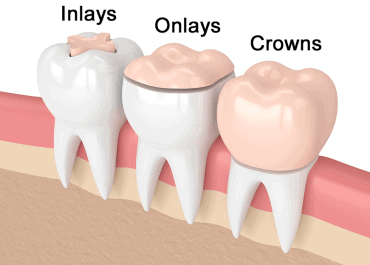
These two terms are strictly determined by the extent to which the restoration covers the elevated chewing points (cusps) of the tooth:
- Inlay (Internal Core Infill): If the cleared decay or structural damage is located entirely within the center of the chewing surface and does not encompass the elevated cusps remaining securely between the intact enamel walls it is defined as an inlay.
- Onlay (External Surface Overlay): If the structural destruction is wider, covering one or more cusps and capping the chewing surface from above, it is defined as an onlay. Onlays function biomechanically as partial crowns (half crowns).
Premium Porcelain Inlay Onlay Filling Materials
The primary restorative standard preferred in contemporary clinical procedures is the porcelain inlay onlay filling system. These restorations are manufactured from high-translucency lithium disilicate (E-Max) or advanced hybrid ceramic blocks baked under high temperatures and vacuum pressures in laboratory ovens.
The primary mechanical benefit of a porcelain block is that its flexural modulus and hardness coefficient directly match natural human dental enamel. Furthermore, because its light transmission profile is flawless, it integrates seamlessly with the surrounding tooth shade, making it completely indistinguishable from real enamel. Because ceramic surfaces possess a non-porous glass-like smoothness, they do not absorb pigments from coffee, tea, or tobacco smoke, remaining entirely stain-resistant over time.
How is an Inlay Onlay Filling Done?
Driven by advanced digital dentistry and computer-aided workflows, the entire procedure is completed within two brief, highly comfortable clinical appointments:
Clearing Decay and 3D Intraoral Scanning
First, all active decay, old defective restorations, and compromised enamel fragments are fully cleared under local anesthesia. The remaining healthy tooth structures are configured into a clean geometric preparation form. Next, instead of utilizing messy traditional trays and impression gels that trigger gag reflexes, a high-definition CAD CAM dental inlay scanning wand captures a precise 3D model of your dentition within seconds. A temporary filling material seals the prepped cavity before discharge.
Laboratory Processing (Computer-Aided CAD/CAM Design)
The digitized 3D impression file is immediately transmitted to the laboratory software matrix. A specialized technician references your bite registration and functional chewing vectors to digitally design the porcelain filling with millimeter-level precision. Once approved, high-strength ceramic blocks are automatically milled via robotic freze systems with zero micro-structural error.
Advanced Adhesive Bonding
Conducted a few days later, the temporary seal is removed, and the manufactured porcelain inlay or onlay is placed into the tooth cavity for structural verification. Once the occlusion balance and marginal fit are verified as flawless, the internal enamel walls are chemically conditioned. Special dual-cure resin cements are applied to both the tooth structure and the porcelain piece, and a high-intensity curing light seals the restoration, achieving a permanent molecular fusion.
Comprehensive Clinical Selection Matrix
Restorative specialists utilize these structured structural criteria to determine the ideal methodology based on missing tooth volume:
|
Structural Criteria & Performance |
Standart Composite Filling |
Inlay / Onlay Filling (Porcelain) |
Full Restorational Dental Crown |
|
Missing Tooth Volume Rate |
Indicated when tooth loss is under 30%. |
Indicated when tooth loss is between 30% and 70%. |
Indicated when tooth destruction exceeds 70%. |
|
Enamel Conservation Depth |
Restricted to clearing local decay (Highly conservative). |
Highly Protective: Only active decay is cleared; healthy tooth walls are left completely untouched. |
Requires a 360-degree reduction of all walls by 1.5 - 2 mm (High enamel loss). |
|
Polymerization Shrinkage Risk |
Present (Direct composites shrink as they cure, risking micro-gaps). |
Zero Risk: Fully processed and cured outside the mouth, ensuring absolute dimensional accuracy. |
Zero Risk (Fabricated outside the mouth). |
|
Stain Accumulation & Wear |
Becomes matte over time; prone to yellowing from dietary stains. |
Stain-Resistant: Glass-like surface completely rejects stains and displays zero wear. |
Stain-resistant and highly resistant to wear. |
|
Average Clinical Lifespan |
Approximately 3 to 5 years. |
10 to 15 Years (Exceptional structural durability). |
Approximately 10 to 15 years. |
How Are Inlay Onlay Filling Costs Calculated?
Stating a single flat fee for "inlay onlay filling costs" or "porcelain inlay onlay filling prices" before an in-person assessment is inaccurate. Final investments track the baseline regulations provided by the Turkish Dental Association alongside these variables:
- The Ceramic Block Material Tier: Whether the indirect piece is milled from pure lithium disilicate (E-Max), zirconium-reinforced ceramics, or hybrid micro-composites directly alters base material costs.
- Advanced CAD/CAM Engineering Fees: Utilizing high-definition intraoral scanning cameras, intelligent design software, and precision robotic milling units requires a premium technology setup, placing these procedures in a higher bracket than standard direct fillings.
- The Scale of the Restoration: The overall physical surface volume and whether the tooth requires an inlay or an extensive onlay dictates the volume of ceramic block material consumed.
Frequently Asked Questions
Do porcelain inlay onlay fillings detach or fall off the tooth over time?
No, the risk of detachment is significantly lower than that of traditional crowns. These indirect restorations do not rely on mechanical friction over a prepared post; instead, they are chemically welded to your natural enamel utilizing an advanced technique called "Adhesive Cementation." Because the tooth structure and the ceramic block achieve a permanent molecular fusion, the restoration cannot loosen or fall out under functional loads.
Can an inlay onlay filling be safely performed on a root canal treated tooth?
Yes, absolutely. In fact, post-endodontic core protection is one of the primary clinical scenarios where this treatment is strongly recommended. Teeth that have undergone root canal therapy become brittle over time due to internal tissue removal and moisture loss. Restoring a non-vital molar with a large direct composite filling leaves it vulnerable to vertical root fractures under heavy loads. Choosing a custom porcelain inlay onlay filling that caps and reinforces the cusps is the most modern approach to extending a non-vital tooth's lifespan.
Is the procedure painful during or after the appointments?
Because the initial decay clearance and structural preparation stages are performed under advanced local anesthesia blocks, it is completely impossible to experience pain or distress during the first visit. The second appointment involves adhesive bonding, which is entirely non-invasive and painless. Patients may note a mild, temporary thermal sensitivity to hot or cold liquids for a few days post-cementation due to the micro-conditioning of the enamel; this resolves naturally.
Can 3D digital impressions for an inlay onlay filling be captured if I have a cold?
Yes. Because we implement advanced 3D digital intraoral cameras instead of traditional impression trays filled with heavy pastes, capturing digital records while managing a common cold is perfectly safe and free of gag reflexes. However, if you are experiencing an active fever or severe coughing fits, it is best to reschedule. It can be challenging to keep your mouth perfectly still during scanning when dealing with intense symptoms, and postponing for a few days ensures a more comfortable experience.
About the Author