


What Is Peri-implantitis? Symptoms, Laser and Antibiotic Treatment
Don't put off your smile. Message us now to discuss your treatment options with our expert dentists.
WhatsAppIn modern dentistry, dental implants are undisputedly the most successful, longest-lasting, and most aesthetic gold standard treatment method for replacing missing teeth. These titanium screws, which are surgically placed into the jawbone, mimic natural tooth roots to perfectly restore chewing function to the mouth. However, being artificial does not mean that implants are completely immune to biological infections. Just as the tissues surrounding natural teeth can become inflamed (periodontitis), the supporting tissues surrounding implants can also be attacked by bacterial plaque.
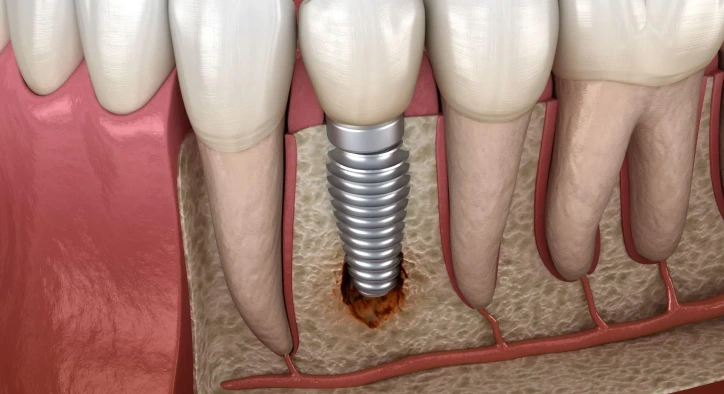
The destructive inflammatory condition that develops in the gums and jawbone surrounding the implant in the years following implant surgery is known in medical literature as peri-implantitis. If not intervened in time, this condition leads to rapid resorption of the alveolar bone holding the implant, causing the high-cost investment to loosen and be completely lost. However, today, thanks to advancing microsurgical and laser technologies, it can be successfully managed. In this comprehensive expert guide, we examine the mechanism and treatment options of peri-implantitis in full detail to help you protect your implant health.
Table of Content
- What is Peri-implantitis and Why Does It Occur?
- What Are the Prominent Peri-implantitis Symptoms?
- How to Treat Dental Implant Infection: Advanced Peri-implantitis Protocols
- Long-Term Maintenance Rules to Prevent Peri-implantitis Formation
- Frequently Asked Questions
- Is an implant suffering from peri-implantitis automatically extracted?
- Can using antibiotics alone cure a dental implant infection completely?
- Does a laser-assisted implant infection treatment cause pain?
- Do individuals with natural teeth or those with dental implants experience gum inflammation more frequently?
What is Peri-implantitis and Why Does It Occur?
The scientific definition of what is peri-implantitis, which stands as the greatest complication threatening the long-term success of dental implants, is as follows: It is a chronic infectious disease that begins with inflammation in the soft tissue around an osseointegrated (fully fused with the jawbone) working implant, and causes progressive resorption (bone loss) in the surrounding alveolar jawbone in later stages.
The first stage before reaching the level of peri-implantitis is termed "peri-implant mucositis." In this phase, the inflammation is restricted exclusively to the gums and has not spread to the bone matrix. However, when mucositis is left untreated, it transforms directly into a peri-implantitis profile. The foundational causes of this destructive inflammation around the implant include:
- Bacterial Plaque and Poor Oral Hygiene: Just as with natural teeth, when the cleaning of implant prostheses is neglected, a microscopic bacterial biofilm accumulates at the neck section where the implant meets the gumline. If this plaque is not disrupted, it migrates downward into the gingival pockets.
- Smoking and Tobacco Use: Tobacco smoke severely constricts blood circulation and compromises the local immune response of the gums surrounding the implant. The risk of developing peri-implantitis in individuals who smoke is approximately 4 to 5 times higher compared to non-smokers.
- Uncontrolled Systemic Diseases: Specifically, uncontrolled Diabetes mellitus (sugar disease) and osteoporosis (bone thinning) reduce the body's baseline capacity to fight infections, thereby accelerating local bone resorption.
- Biomechanical Overloading (Bruksizm): When a patient unconsciously clenches or grinds their teeth at night, or when there are errors in load distribution over the prosthetic framework, it creates micro-fractures in the surrounding bone, allowing bacteria to easily penetrate the bone matrix.
- Residual Cement: Microscopic luting cement residues left beneath the gumline while bonding implant-supported porcelain/zirconium crowns initiate a foreign body reaction, setting the stage for infection.
What Are the Prominent Peri-implantitis Symptoms?
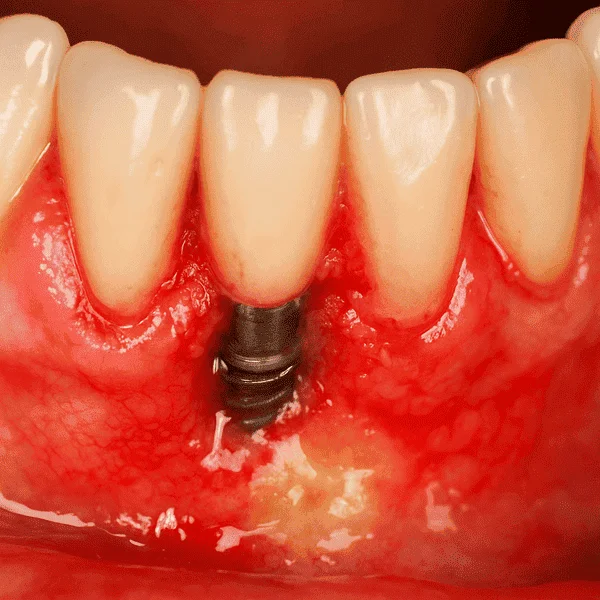
Because there are no vital nerve tissues surrounding the structural titanium bodies of dental implants, peri-implantitis progresses without producing sharp pain and behaves in an highly silent manner during its early stages. Patients generally fail to realize the severity of the situation until bone loss reaches an advanced state. The most prominent peri-implantitis symptoms requiring clinical tracking include:
- Gingival Bleeding and Erythema: Bleeding of the gums around the implant during brushing, eating, or spontaneously, and the soft mucosal tissue taking on a dark red or purple hue is the earliest signal.
- Suppuration (Pus Discharge) Around the Implant: When light digital pressure is applied to the margin of the implant, a white-yellow, foul-smelling active purulent exudate discharges from the pocket, showing that the infection is deepening.
- Gum Recession and Metal Structural Exposure: As the alveolar bone holding the implant resorbs, the overlying soft tissue recedes downward. Consequently, the grey-colored titanium thread lines or the abutment component of the implant become visible inside the mouth.
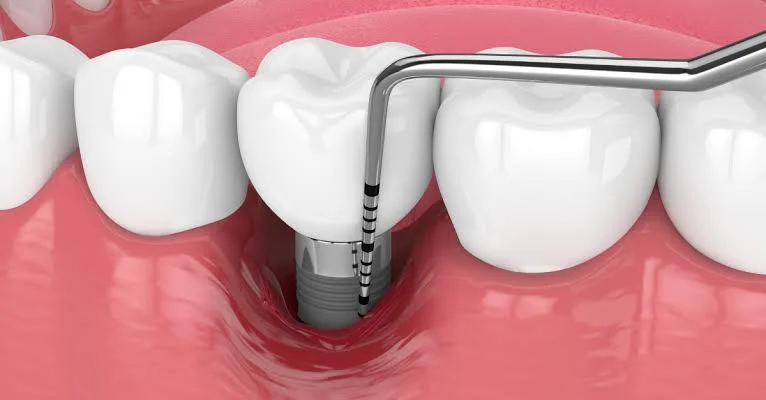
- Deepening Peri-implant Pockets: During clinical evaluations performed by a periodontist, it is recorded that the probing depth around the implant has exceeded 4-5 mm and presents immediate bleeding upon probing.
- Radiographic Bone Loss: High-resolution panoramic or periapical x-rays cleanly track that the jawbone around the titanium threads has undergone vertical resorption, displaying a characteristic crater-like bone loss.
- Implant Mobility (Sallanma): This symptom represents the terminal and most dangerous stage of peri-implantitis. When the bone scaffolding holding the implant is entirely resorbed, the implant begins to wobble. Saving an implant at this stage is unfortunately biologically impossible.
How to Treat Dental Implant Infection: Advanced Peri-implantitis Protocols
Answering the query how to treat dental implant infection requires stating a clear clinical fact: The bone loss and active infection surrounding a dental implant can never be resolved at home using mouthwashes or simply relying on antibiotics. To achieve a successful cure, targeted intervention by an expert periodontist (gum disease specialist) is mandatory.
The clinical peri-implantitis treatment frameworks are executed through these sequential steps based on infection severity:
1. Non-Surgical Decontamination (Mechanical Debridement)
During early interventions, the peri-implant pockets are fully cleared of bacterial plaque and calculus utilizing specialized ultrasonic scalers and non-metal carbon/plastic curettes that protect the smooth titanium surface from scratches. The area is then intensively flushed with sterile antiseptic solutions (such as chlorhexidine).
2. Specialized Peri-implantitis Antibiotic Treatment
To lower local microbial counts alongside mechanical debridement, a targeted peri-implantitis antibiotic treatment is implemented. Systemic broad-spectrum antibiotics (typically combinations of amoxicillin and metronidazole) targeting specific anaerobic pathogens within the oral microflora are prescribed by the physician. Additionally, introducing slow-release antibiotic gels (such as local doxycycline) directly inside the infected pocket is highly effective in drying out the localized infection reservoir.
3. Laser Peri-implantitis Treatment
Today, dental laser technologies have revolutionized the management of peri-implant diseases. Laser peri-implantitis treatment stands as the most successful methodology for eliminating microscopic bacterial colonies trapped between intricate titanium threads where manual mechanical scaling tools cannot reach. Specialized wavelengths (such as Er:YAG or Diode lasers) instantly vaporize the bacterial biofilm layer within seconds (photoacoustic decontamination) without generating thermal damage on the titanium body or surrounding bone matrix. The laser simultaneously biostimulates local blood circulation, triggering biological tissue healing and encouraging bone cells to fuse with the implant again.
4. Surgical Debridement and Grafting (Regenerative Approach)
If radiological tracking reveals advanced bone loss, the clinician switches to a surgical protocol. The gum flap is surgically reflected (flap operation), and the infected titanium yiv surfaces are completely cleared of toxins using specialized chemical agents and lasers (detoxification). Following surface preparation, high-grade bone powder (bone graft) materials are packed into the empty crater to regenerate the missing bone matrix, covered with protective bio-resorbable membranes, and the gum tissue is neatly sutured back.
Evaluating Peri-implantitis Infection Stages
Reference this clinical breakdown to determine the impact of various infection levels on your dental implant structure:
|
Infection Stage / Status |
Primary Clinical Signs |
Alveolar Bone Resorption Index |
Preferred Primary Clinical Treatment |
|
Peri-implant Mucositis |
Gum redness, bleeding during regular brushing. |
Absent (Restricted strictly to soft tissue) |
Mechanical scaling, home hygiene adjustment, antiseptic rinses. |
|
Mild Peri-implantitis |
Probing depth 4-5 mm, light bleeding/suppuration. |
Early-stage vertical bone loss initiated. |
Laser decontamination + Localized antibiotic gels |
|
Advanced Peri-implantitis |
Deep pockets (>6 mm), gum recession, active pus. |
Intense crater-like localized bone structure loss. |
Surgical Flap Debridement + Bone Powder (Grafting) |
|
Terminal (End) Stage |
Clear structural mobility; implant wobbles visually. |
Complete collapse of the supporting bone scaffolding. |
Surgical Implant Removal (Restoration is impossible) |
Long-Term Maintenance Rules to Prevent Peri-implantitis Formation
Treating an infected implant is vastly more complex than preventing the onset of peri-implantitis. To ensure your dental implants maintain optimal health and last a lifetime, follow these protective home care instructions diligently:
- Implement Specialized Interdental Floss and Proximal Brushes: Standard toothbrushes cannot navigate the unique undercuts of implant restorations. You must utilize specialized thick implant floss (such as Superfloss) and properly calibrated interdental brushes daily.
- Daily Intraoral Water Flosser Execution: Utilizing a water flosser that emits a pressurized stream of water is the most effective way to mechanically flush out trapped food debris situated between the implant prosthesis and the gumline.
- Routine Professional Cleanings Every 6 Months: Implant patients must visit their dentist at least twice a year, even if they have no active symptoms. Professional clinical scaling and regular radiographic auditing are the only pathways to catch peri-implantitis during its initial, non-destructive phases.
- Complete Tobacco Cessation: Smoking directly sabotages the long-term survival rates of dental implants and must be completely discontinued.
Frequently Asked Questions
Is an implant suffering from peri-implantitis automatically extracted?
No, absolutely not. If the infection is detected during its early or intermediate structural stages, laser systems, advanced antibiotic protocols, and bone grafting procedures can thoroughly dry out the infection, halt progressive bone loss, and successfully save the implant inside the mouth. An implant is only extracted when it enters the terminal stage, meaning it has completely lost its bony support and exhibits clear clinical mobility.
Can using antibiotics alone cure a dental implant infection completely?
No, it cannot. A peri-implantitis antibiotic treatment is purely an auxiliary component designed to suppress acute swelling and control systemic bacterial spreading. Unless the mineralized bacterial biofilm (calculus) adhering to the raw titanium surface is mechanically scraped away by a specialist and fully decontaminated via lasers, the inflammation will return with greater intensity shortly after the antibiotic course ends.
Does a laser-assisted implant infection treatment cause pain?
No, it does not. Non-surgical laser protocols typically do not even require local anesthesia; patients report experiencing only a mild sensation of warmth or a light clicking sound. If the condition requires a surgical flap procedure to access deeper bone defects, the entire treatment is performed under profound local anesthesia blocks, ensuring that the patient feels absolutely zero pain during or after the procedure.
Do individuals with natural teeth or those with dental implants experience gum inflammation more frequently?
The baseline risk of developing gum inflammation tracks your oral hygiene diligence in both scenarios. However, from an anatomical standpoint, natural teeth are enveloped by a resilient network of protective connective tissue fibers (periodontal ligaments) and a highly dense vascular grid compared to dental implants. Implants possess a weaker biological barrier against bacterial pathogens. Consequently, the surrounding structures are more vulnerable, meaning that if oral hygiene drops, bone loss around an implant progresses at a much faster and more destructive rate than around a natural tooth.
About the Author