


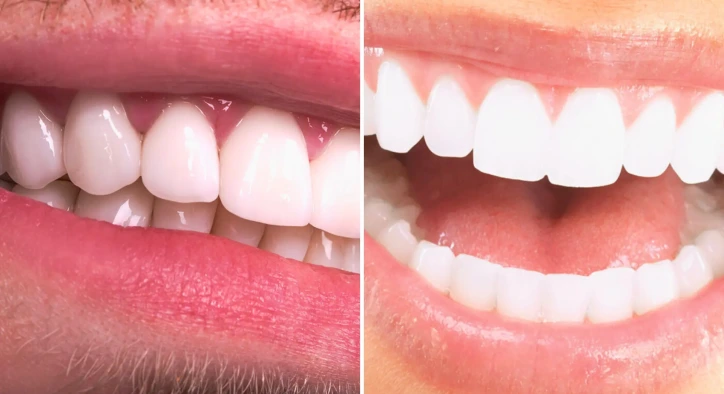
Zirconium or Laminate Veneers? Which is Better & Costly?
Don't put off your smile. Message us now to discuss your treatment options with our expert dentists.
WhatsAppIn a modern world driven by visual presence, achieving a flawless smile is one of the most significant assets for personal and professional confidence. The rapid evolution of digital dental software and biomimetic materials allows individuals dissatisfied with tooth coloration, minor crowding, or gaps to access highly protective cosmetic alternatives. However, during the initial planning phases of a comprehensive smile makeover (Hollywood Smile), the most frequent dilemma facing patients is this: Zirconium or laminate?
Both alternative treatments represent premium, metal-free systems that entirely eliminate the opaque look and dark gumline discoloration associated with older metal-fused restorations. However, their biomechanical properties, required preparation configurations, enamel shaving depths, and light transmission variables are completely distinct. This comprehensive guide covers both systems using objective clinical criteria to help you determine the optimal pathway for your dentition.
Table of Content
Is Zirconium or Laminate Better? Biomechanical and Optical Comparison
When exploring cosmetic modifications, patients naturally query: is zirconium or laminate better? In advanced operative dentistry, there is no single absolute material; there is only the specific material that best matches the patient’s occlusion pattern, biological thickness, and functional requirements. To determine which is superior for your unique smile line, we must analyze their fundamental performance criteria.
Enamel Shaving and Depth Configuration
The most significant biological divider between these two popular treatments is the extent of reduction required on healthy tooth structures:
- Porcelain Laminate Veneers: Require an ultra-conservative modification restricted exclusively to the front wall of the tooth, ranging between a microscopic 0.3 and 0.7 mm. The rear surfaces, interproximal sides, and primary biting ridges remain mostly untouched. In highly ideal arrangements, "No-Prep Veneers" can even be bonded with zero enamel shaving. This makes laminates the most non-invasive structural solution in cosmetic dental medicine.
- Zirconium Crowns: Require a circumferential, 360-degree reduction where all walls (anterior, posterior, sides, and incisal edges) are shaved down by approximately 1.5 to 2 mm. This reduction is mandatory to allow the high-strength zirconium crown to cover the tooth structure securely like a cap. Consequently, if your teeth are structurally intact and free of heavy decay, selecting full zirconium solely for cosmetic reasons causes significantly more enamel loss compared to thin veneers.
Optics, Translucency, and Lifelike Vitality
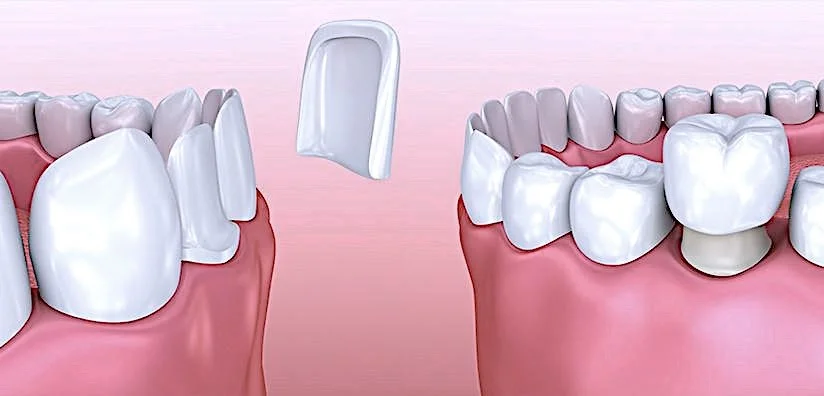
Natural human teeth exhibit a gradient of translucency; light penetrates the outer enamel layer and reflects off the underlying dentin, creating natural depth:
- Laminate Veneers (Glass-Ceramics / E-Max): Crafted from lithium disilicate blocks, these micro-thin sheets feature a light transmission profile that matches real enamel nearly 100%. Because they allow light to pass through smoothly and interact with the natural tooth underneath, they present an unmatched lifelike vitality that is completely indistinguishable from real teeth.
- Zirconium Restorations: Composed of zirconium dioxide, a high-strength crystalline structure. While their translucency is vastly superior to older metal crowns, they are inherently more opaque than glass-ceramics. This denser white profile gives them an exceptional clinical masking ability, allowing them to perfectly cover teeth that have turned dark grey due to extensive root canals, silver fillings, or tetracycline staining.
Structural Strength and Resistance to Heavy Load
The internal flexural strength of a dental material determines where it can be safely positioned within the mouth:
- Zirconium: Displays an incredibly high fracture resistance and flexural threshold. This exceptional mechanical toughness allows full zirconium to easily withstand massive vertical biting loads, making it the premier selection for rear molars and multi-unit missing teeth restorations via dental bridges.
- Laminate Veneers: Prior to chemical bonding, these thin shells are highly fragile. However, once fused to the natural enamel using advanced resin bonding agents, they integrate into the tooth architecture, gaining great resistance against standard functional forces. Because they lack high flexural strength across open spans, they can never be utilized to construct a dental bridge over missing teeth.
Cost Evaluation: Is Zirconium or Laminate More Expensive?
Financial mapping is another primary factor for patients evaluating a full smile transformation, making the query is Zirconium or Laminate more expensive highly relevant.
From a clinical and manufacturing perspective, porcelain laminate veneer treatment is significantly more expensive and carries a premium cost structure compared to standard zirconium crowns.
The primary factors driving this cost difference include:
- Micro-Engineering and Laboratory Detail: Because laminate veneers are fabricated down to an ultra-thin 0.3 mm profile, they require advanced CAD/CAM robotic milling calibrations and meticulous, high-magnification manual laboratory detailing. Replicating natural tooth dynamics without fracturing the micro-thin ceramic matrix scales production costs significantly.
- Advanced Chemical Bonding Protocols: Adhesive cementation for laminate veneers is a highly technical clinical process compared to standard crown cementation. It requires an environment completely isolated from oral moisture (utilizing a rubber dam) and the application of chemical conditioners, silane agents, and light-cured translucent resins in a precise sequence. This complex procedure demands advanced clinical expertise, which directly shapes pricing structures.
- Raw Block Material Tier: The high-translucency lithium disilicate (such as E-Max or IPS Empress) blocks utilized for premium veneers carry higher base manufacturing and import costs than traditional zirconium oxide blocks.
Frequently Asked Questions
Do laminate veneers detach or fall off easily compared to zirconium crowns?
Laminate veneers are secured using advanced chemical resin cements that create a permanent molecular fusion with your natural tooth enamel. When executed following precise dry-field protocols, it is nearly impossible for a veneer to spontaneously loosen, detach, or fall off on its own. While standard crowns rely heavily on mechanical friction over a prepared post, veneers chemically weld directly to the tooth structure.
Will a zirconium crown cause dark grey or purple gumline discoloration over time?
No. One of the greatest clinical benefits of zirconium dioxide is its complete biological neutrality and tissue compatibility. Because it contains no non-noble base metals, it will never oxidize or cause the dark grey margins or purple shadows often seen at the gumline with traditional porcelain-fused-to-metal (PFM) restorations. It is entirely friendly to soft gingival tissues.
Can laminate veneers be safely placed on patients who grind their teeth?
Placing thin laminate veneers is highly risky for individuals with severe, unmanaged nocturnal teeth grinding (bruxism), as intense lateral forces can easily fracture micro-thin glass-ceramics. If veneers are chosen for the aesthetic zone of a bruxism patient, therapeutic interventions like masseter Botox must be implemented first to reduce biting force, and the patient must wear a custom night guard consistently. If compliance cannot be guaranteed, full-coverage monolithic zirconium crowns represent a much safer mechanical solution.
About the Author