

E-max or Zirconia: Differences, Costs, Aesthetics & Strength
Don't put off your smile. Message us now to discuss your treatment options with our expert dentists.
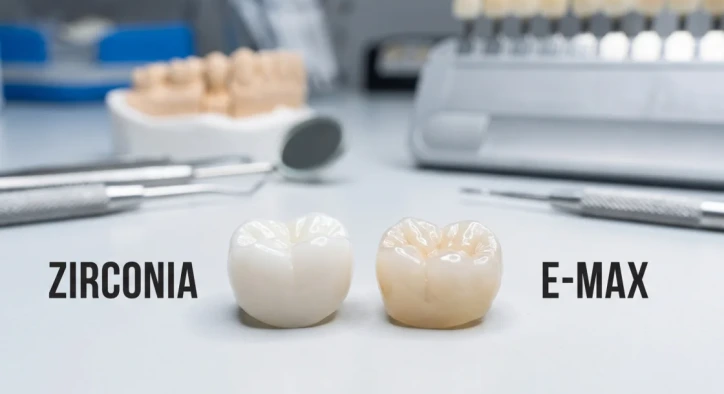
WhatsAppWhen planning smile makeovers and aesthetic dental restorations, one of the primary decisions patients face is selecting the optimal restorative material. Among metal-free all-ceramic options that have largely superseded traditional porcelain-fused-to-metal (PFM) crowns, two materials dominate modern prosthodontics: Lithium Disilicate glass-ceramics (E-max) and high-strength metal-oxide ceramics (Zirconia). Both options eliminate dark gingival lines and exhibit high biocompatibility; however, their optical translucency, flexural strength, and mechanical properties differ significantly.
Determining whether e-max or zirconia is superior requires analyzing the restoration site (anterior aesthetic zone versus posterior high-load occlusal tables), patient parafunctional habits (bruxism), and underlying tooth discoloration. This comprehensive YMYL master guide analyzes the difference between e-max and zirconia, answers is e-max more expensive than zirconia, outlines what is e-max veneer, details how is e-max made, and clarifies clinical indications for zirconia crown placements.
Table of Content
- What is an E-max Veneer? Biological Structure
- What is a Zirconia Crown?
- What is the Difference Between E-max and Zirconia?
- How is E-max Made? Workflow Steps
- Is E-max More Expensive Than Zirconia?
- E-max vs Zirconia Crowns: Material Selection Guidelines
- Comparative Matrix: E-max vs. Zirconia Restorations
- Frequently Asked Questions
What is an E-max Veneer? Biological Structure
In prosthodontic literature, the scientific answer to what is e-max veneer is: A monolithic glass-ceramic restoration fabricated from lithium disilicate (Li2Si2O5) crystals, processed via CAD/CAM milling or press technology, offering optical translucency and light-refraction properties that closely mimic natural dental enamel.
E-max (IPS e.max) features zero metallic or opaque core substructures. Composed entirely of translucent ceramic crystals, it allows light to pass directly through the restoration, replicating the depth, vitality, and opalescence of natural teeth.
What is a Zirconia Crown?
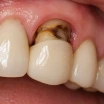
A zirconia crown is constructed from zirconium dioxide (ZrO2), a high-performance ceramic compound providing metallic-grade mechanical durability with a white tooth-colored appearance. Zirconia serves as a high-strength core framework or as a monolithic restoration engineered to withstand heavy posterior chewing forces.
What is the Difference Between E-max and Zirconia?
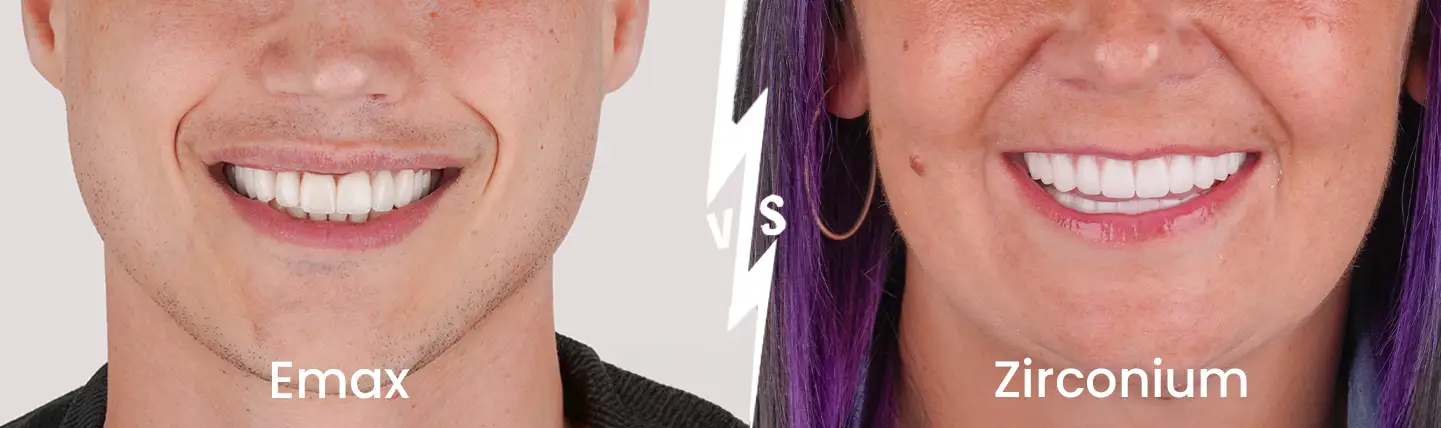
From aesthetic and mechanical perspectives, the difference between e-max and zirconia centers on four clinical parameters:
- Optical Translucency and Aesthetics: E-max exhibits superior optical translucency due to its glass-crystal matrix, capturing natural enamel translucency under ambient lighting. Zirconia is aesthetically pleasing but naturally more opaque, reflecting rather than transmitting light to the same degree as E-max.
- Flexural Strength: Zirconia demonstrates a flexural strength of 1000 to 1200 MPa, whereas E-max displays a flexural strength of 400 to 500 MPa. Consequently, Zirconia provides greater resistance to heavy mechanical masticatory stress.
- Clinical Indications: E-max is the primary material for single anterior crowns, veneers, inlays, and onlays in the aesthetic zone. Zirconia is indicated for high-load posterior molars, multi-unit bridges, and patients with bruxism.
- Tooth Reduction Depth: E-max veneers require minimal tooth preparation (0.3 to 0.7 mm), whereas zirconia crowns typically require 1.0 to 1.5 mm of circumferential axial reduction.
How is E-max Made? Workflow Steps
Understanding how is e-max made involves the following structured clinical and laboratory phases:
- Preparation & Digital Scanning: Minimal tooth structure is removed, and a 3D intraoral digital scan is captured.
- CAD Design: The digital restoration is designed using 3D CAD software to match the patient's smile line and occlusion.
- CAM Milling: A lithium disilicate block is milled using precision computer-guided milling burs.
- Crystallization Firing & Staining: The milled restoration undergoes high-temperature crystallization firing to achieve its final flexural strength, followed by custom ceramic staining and glazing.
- Adhesive Resin Bonding: The finished E-max restoration is chemically bonded to the prepped tooth using light-cured adhesive resin cements.
Is E-max More Expensive Than Zirconia?
When considering treatment budgets, patients frequently ask: is e-max more expensive than zirconia?
In clinical practice, E-max restorations are generally more expensive than Zirconia crowns. The higher manufacturing cost of lithium disilicate blocks, specialized crystallization equipment, and precise adhesive bonding protocols contribute to a higher unit cost for E-max restorations.
E-max vs Zirconia Crowns: Material Selection Guidelines
When deciding between e-max vs zirconia crowns, prosthodontists follow these biomechanical guidelines:
- For Anterior Teeth: Because optical light transmission is critical, E-max is preferred for anterior 6 to 8 teeth.
- For Posterior Molars: Because load-bearing strength is paramount, Zirconia is preferred for posterior molars.
- For Multi-Unit Bridges: For replacing missing teeth with multi-unit bridges, Zirconia must be selected. E-max lacks the flexural strength required for multi-unit span connectors and carries a risk of fracture in bridge configurations.
- For Severely Discolored Cores: To mask dark underlying tooth structure or metal post-and-cores, Zirconia's opacity is advantageous over translucent E-max.
Comparative Matrix: E-max vs. Zirconia Restorations
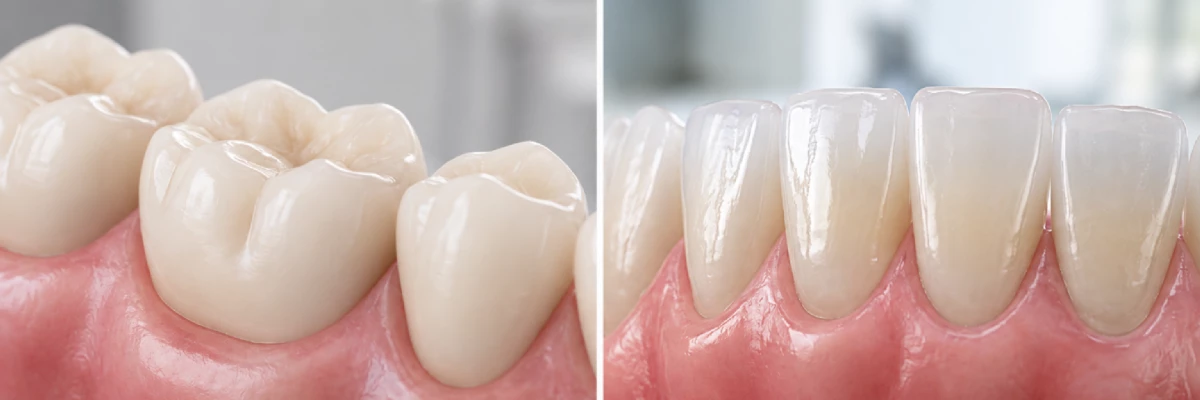
Review the key technical parameters comparing E-max and Zirconia below:
|
Technical & Aesthetic Criteria |
E-Max (Lithium Disilicate Glass-Ceramic) |
Zirconia (ZrO2 Oxide Ceramic) |
|
Flexural / Fracture Strength |
~400 - 500 MPa |
~1000 - 1200 MPa (Very High) |
|
Optical Translucency |
Maximum (Identical to natural enamel) |
Moderate / High (More Opaque) |
|
Primary Clinical Indication |
Anterior Teeth, Thin Veneers, Inlays |
Posterior Molars, Implant Crowns, Bridges |
|
Multi-Unit Bridge Capability |
Contraindicated for multi-unit bridges |
Fully Indicated for Multi-Unit Bridges |
|
Masking Dark Tooth Cores |
Low (May transmit underlying dark tones) |
High (Effectively masks dark abutments) |
|
Relative Cost Tier |
Higher |
High (More accessible than E-Max) |
Frequently Asked Questions
Can an E-max crown break?
While E-max lithium disilicate glass-ceramics possess high flexural strength, they are not as tough as Zirconia. Under normal anterior chewing forces, E-max is highly durable. However, biting on hard objects or severe nocturnal teeth grinding (bruxism) can risk fracturing E-max. Bruxism patients must wear a nightguard to protect E-max restorations.
Does a zirconia crown change color over time?
No. The glazed surface of both Zirconia and E-max restorations is non-porous. Staining agents from coffee, tea, or tobacco cannot penetrate the glazed ceramic surface, preventing color alteration.
Does E-max cause gum discoloration or dark lines?
No. Unlike older porcelain-fused-to-metal (PFM) crowns, neither E-max nor Zirconia contains metal alloys. Both materials are biocompatible and will not produce dark gray margins at the gumline.
Which lasts longer: E-max or Zirconia?
Both materials offer a lifespan exceeding 10 to 15 years with proper oral hygiene and routine dental checkups. Zirconia demonstrates higher mechanical longevity in heavy posterior load zones, while E-max provides exceptional chemical bond longevity on anterior teeth.
About the Author