


Do Dental Implants Interfere with MRI Scans?
Don't put off your smile. Message us now to discuss your treatment options with our expert dentists.
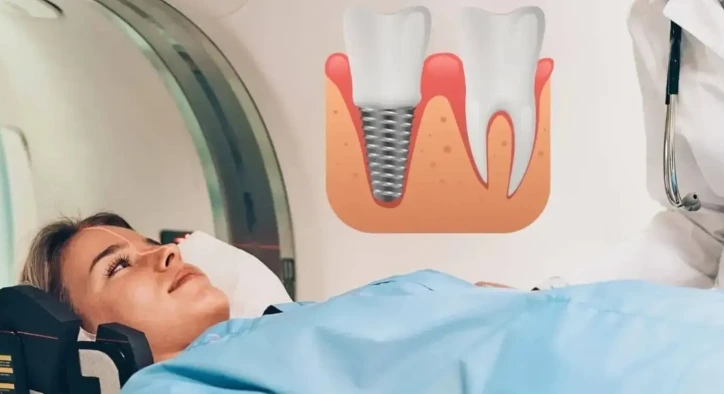
WhatsAppMagnetic Resonance Imaging (MRI) is a non-invasive diagnostic imaging modality that utilizes high-intensity static magnetic fields, gradient fields, and radiofrequency pulses to generate detailed anatomical images of soft tissues, the brain, the spine, and internal organs. Standard diagnostic MRI units operate at magnetic field strengths of 1.5 Tesla (T) or 3.0 Tesla (T). Because of these strong magnetic fields, patients must remove external metallic accessories, jewelry, and watches prior to entering the MRI scanner room.
At this point, many patients with implants naturally wonder whether a dental implant MRI scan poses any safety concerns. You can explore how magnetic fields interact with implants and all essential safety details throughout the rest of our guide.
Table of Content
- Can People with Dental Implants Get an MRI? Clinical Safety
- Why Dental Implants Are Safe for MRI Scanners: Material Science
- Do Dental Implants Move, Dislodge, or Heat Up During an MRI?
- Do Dental Implants Distort MRI Images?
- Comparative Matrix: Dental Materials and MRI Compatibility
- Patient Checklist Prior to an MRI Scan
- Frequently Asked Questions
Can People with Dental Implants Get an MRI? Clinical Safety
According to international radiological safety standards, the answer to can a person with an implant have an mri is: Yes, individuals with dental implants can safely undergo MRI scans.
Dental implants do not pose an obstacle to MRI examinations. Whether undergoing a brain scan, spinal imaging, or full-body diagnostic assessment, dental implants remain safe and do not cause physical harm or health emergencies.
Why Dental Implants Are Safe for MRI Scanners: Material Science
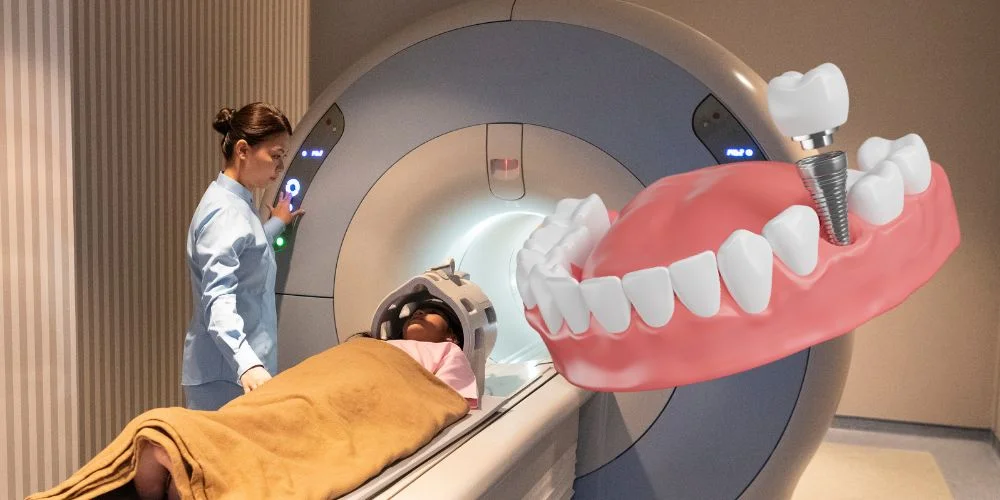
Concerns regarding is dental implant an obstacle to mri stem from how different metals interact with magnetic fields:
- Ferromagnetic Metals (Attracted to Magnets): Iron, nickel, and cobalt experience strong physical displacement forces within magnetic fields. These materials can dislodge, torque, or undergo significant inductive heating in an MRI environment.
- Non-Ferromagnetic Metals (Non-Magnetic): Titanium and zirconium dioxide (zirconia ceramic) do not interact with magnetic fields.
Standard contemporary dental implants are manufactured exclusively from commercially pure Grade 4 Titanium, Grade 5 Titanium Alloy (Ti-6Al-4V), or Zirconia (Ceramic). Because titanium and zirconia are non-ferromagnetic, they experience no magnetic attraction or displacement forces inside 1.5T or 3.0T MRI scanners.
Do Dental Implants Move, Dislodge, or Heat Up During an MRI?
Clinical investigations address two common patient concerns:
- Risk of Mechanical Displacement: Once surgically placed in the alveolar ridge, dental implants undergo osseointegration, forming direct structural contact with living bone cells. Because titanium is non-magnetic, MRI magnetic fields exert zero translational attraction or rotational torque on the implant.
- Thermal Inductive Heating: Radiofrequency energy delivered during scanning can theoretically induce electrical currents in conductive materials. However, dental implants possess small surface areas, and surrounding alveolar bone microcirculation provides continuous thermal dissipation. Peer-reviewed in-vitro and in-vivo trials confirm that temperature elevations around titanium implants during 3T scans remain below 0.5 degrees Celsius, well below the threshold for thermal cellular injury.
Do Dental Implants Distort MRI Images?
While dental implants do not cause physical harm, they can generate local susceptibility artifacts (image distortion) on specific scans:
- Head, Neck, and Maxillofacial Scans: When scanning structures adjacent to the oral cavity (such as the tongue, mandible, or floor of the mouth), metallic fixtures can cause localized dark signal voids or geometric distortions measuring a few millimeters around the hardware.
- Distant Anatomical Scans: Lumbar spine, cardiac, pelvic, knee, or abdominal MRIs remain unaffected by dental implants.
- Radiological Optimization: Informing the imaging technologist about your dental implants allows the radiologist to implement Metal Artifact Reduction Sequences (MARS), minimizing local image distortion.
Comparative Matrix: Dental Materials and MRI Compatibility
|
Dental Restorative Material |
Composition |
Magnetic Attraction / Displacement |
Heating Risk |
Image Artifact Potential |
|
Titanium Dental Implant |
Pure Titanium (Grade 4/5) |
Zero Attraction (MR-Safe) |
None / Negligible |
Low (Confined to implant site) |
|
Zirconia Implant / Crown |
Zirconium Dioxide (Ceramic) |
Zero Attraction (MR-Safe) |
None |
Zero Artifact (Clear image) |
|
Porcelain-Fused-to-Metal |
Nickel-Chromium / Cobalt-Chrome |
Minimal / Safe |
Low |
Moderate Local Distortion |
|
Amalgam (Silver) Filling |
Mercury, Silver, Tin Alloy |
Safe |
None |
Small Localized Distortion |
|
Composite (White) Filling |
Resin Matrix & Silica Fillers |
Completely Safe |
None |
Zero Artifact |
Patient Checklist Prior to an MRI Scan
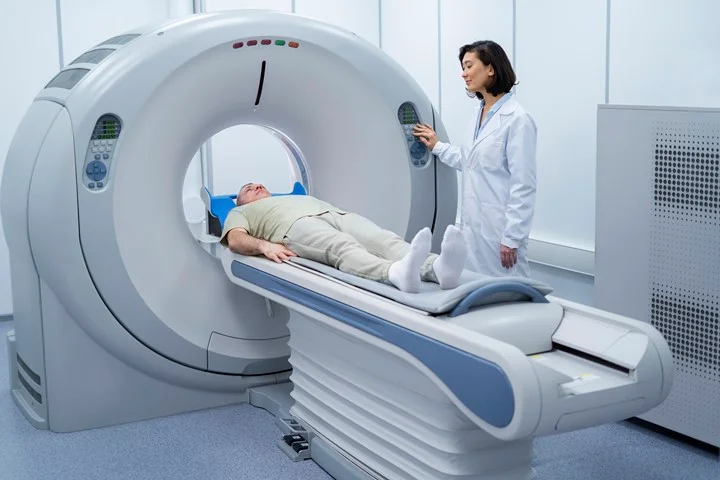
Follow these practical steps when preparing for an MRI appointment:
- Notify Imaging Staff: Inform the MRI technologist and radiologist that you have titanium or zirconia dental implants.
- Remove Removable Dentures: If you wear implant-retained overdentures with snap attachments or metal clips, remove the prosthesis before entering the scanner. The integrated titanium abutments remain safely in your mouth.
- Carry Your Implant ID Card (If Available): Keep the manufacturer implant passport card provided by your oral surgeon in your records should clinical staff request material specifications.
Frequently Asked Questions
Can you get an MRI the day after dental implant placement surgery?
Yes. Even if your dental implant was placed recently, titanium does not respond to magnetic fields. The magnetic environment will not pull on your sutures or destabilize the healing implant, allowing urgent diagnostic MRI procedures to proceed safely.
Are 3.0 Tesla MRI scanners safe for dental implants?
Yes. Titanium and zirconia dental implants remain non-magnetic in both 1.5 Tesla and high-field 3.0 Tesla scanners. Biomedical evaluations confirm that dental implants are MR-Safe across standard clinical field strengths.
Can MRI radiofrequency waves crack porcelain or zirconia crowns?
No. Magnetic resonance fields and radiofrequency pulses do not exert mechanical, acoustic, or structural stresses capable of fracturing ceramic, zirconia, or porcelain dental crowns.
Will dental implants trigger metal detectors or MRI safety alarms?
No. Small intraoral titanium implants do not trigger machine safety faults or interfere with the normal operational electronics of diagnostic MRI systems.
About the Author